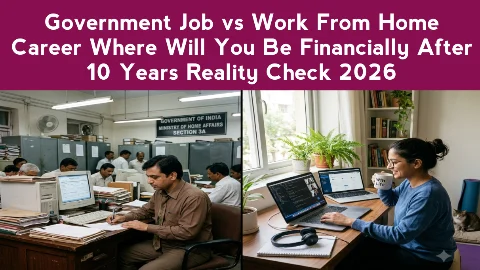
Choosing a career is no longer just about finding a stable job. Today’s professionals also think about financial freedom, flexibility, savings, investments, and long term wealth creation. This is why many students and young professionals often compare a Government job with a Work From Home career.
Both career paths have their own advantages. Government jobs provide predictable salary growth, excellent job security, retirement benefits, and structured promotions. Work From Home careers offer flexibility, higher earning potential in many industries, opportunities to work for global companies, and the possibility of creating multiple income sources.
The important question is not which career pays more today. The real question is where you are likely to stand financially after ten years. The answer depends on income growth, spending habits, career stability, and your ability to continuously improve your skills.
Understanding Both Career Paths
Government Job
A Government employee usually works under Central or State Government departments. Salaries follow structured pay levels with regular increments, Dearness Allowance revisions, retirement benefits, and defined promotion policies.
Work From Home Career
A Work From Home professional may work as a software developer, digital marketer, content creator, graphic designer, video editor, consultant, virtual assistant, customer support executive, or freelancer. Income depends on skills, performance, clients, and market demand.
Financial Comparison Overview
| Factor | Government Job | Work From Home Career |
|---|---|---|
| Income Stability | Excellent | Depends on Skills and Clients |
| Salary Growth | Steady | Potentially Very Fast |
| Job Security | Very High | Varies by Industry |
| Location Flexibility | Limited | Excellent |
| Retirement Benefits | Available | Self Planned |
| Income Ceiling | Moderate | Very High |
Salary Growth During Ten Years
Government salaries increase gradually through annual increments, Dearness Allowance revisions, and promotions. This creates a predictable financial journey. Employees can usually estimate their income years in advance, making financial planning easier.
Work From Home careers are different. Income may remain average for the first few years but can increase rapidly when professionals develop valuable skills, gain international clients, or move into higher paying industries such as software development, artificial intelligence, digital marketing, or consulting. Remote professionals can also switch employers more easily than Government employees, which may accelerate salary growth. Recent career trend reports continue to highlight faster earning potential in high demand private and remote roles for skilled professionals.
Savings Potential
Government employees benefit from a fixed monthly income, making disciplined saving relatively easier. Many also receive allowances that reduce personal expenses, allowing long term investments through provident funds, retirement schemes, and systematic investment plans.
Work From Home professionals often save money by avoiding daily travel, relocation expenses, and office related costs. However, income fluctuations require better financial discipline. Those who budget carefully can build substantial wealth over time despite irregular income.
Lifestyle Differences
| Aspect | Government Job | Work From Home Career |
|---|---|---|
| Working Hours | Mostly Fixed | Flexible |
| Travel Requirement | Depends on Department | Minimal |
| Home Time | Moderate | High |
| Professional Freedom | Limited | Very High |
| Career Flexibility | Structured | Excellent |
Investment Opportunities
Government employees generally invest through structured financial planning because of predictable income. Remote professionals, especially freelancers and business owners, may generate higher surplus income during successful years, allowing larger investments in equity, mutual funds, businesses, or real estate. At the same time, they should maintain emergency funds because income can fluctuate depending on projects and market demand.
Who Builds More Wealth After Ten Years?
The answer depends less on the profession and more on personal financial habits. A disciplined Government employee who saves consistently can accumulate significant wealth over a decade. Likewise, a skilled remote professional who continuously upgrades skills, increases earnings, and invests wisely may achieve even higher financial growth because remote careers often have fewer limits on income. The trade off is that remote work usually involves greater income uncertainty compared to Government service.
Career Growth After Ten Years
Career growth follows very different paths in these two professions. Government employees usually receive promotions based on service rules, departmental examinations, seniority, and performance. This creates predictable career progression but the pace may be slower.
In contrast, professionals working from home can increase their income much faster if they continuously upgrade their skills. A software developer, digital marketer, consultant, designer, or content creator may double or even triple earnings within a few years by working with international clients or launching independent businesses. However, this growth depends entirely on performance and market demand rather than fixed promotion rules.
Job Security Comparison
| Factor | Government Job | Work From Home Career |
|---|---|---|
| Employment Security | Excellent | Depends on Employer or Clients |
| Monthly Income | Highly Predictable | May Fluctuate |
| Career Risk | Low | Moderate |
| Income Potential | Moderate | Very High |
Lifestyle and Personal Freedom
Work From Home careers provide greater flexibility. Professionals can often choose where they live, reduce commuting expenses, and spend more time with family. They may also work with multiple clients or develop additional income sources.
Government employees enjoy structured working hours, paid leave, medical benefits, and long term stability. Their lifestyle is generally more predictable, although transfers may occur depending on the department.
Financial Reality After Ten Years
If two equally disciplined individuals start their careers today, the Government employee is likely to build wealth steadily through regular salary increases, retirement contributions, and consistent savings.
The Work From Home professional has the potential to accumulate greater wealth, but only by maintaining in demand skills, managing finances carefully, and adapting to changing market conditions. Those who stop learning or depend on a single client may experience slower financial growth.
Advantages of Government Jobs
- Excellent job security.
- Predictable salary growth.
- Retirement benefits.
- Medical facilities.
- Structured promotions.
- Lower financial uncertainty.
Advantages of Work From Home Careers
- Flexible working hours.
- Opportunity to work for global companies.
- Higher income ceiling.
- Multiple income sources are possible.
- Lower commuting expenses.
- Location independence.
Which Career Should You Choose?
If financial stability, predictable income, and long term security are your highest priorities, a Government job remains one of the strongest career choices. It provides a structured financial journey with relatively low risk.
If you enjoy learning new technologies, adapting to changing industries, taking calculated risks, and building multiple income streams, a Work From Home career may create greater wealth over the long term. Success, however, depends on continuous skill development and disciplined financial planning.
Final Words:
Choosing between a Government job and a Work From Home career should never be based only on today’s salary. Think about where you want to be financially, professionally, and personally after ten years. Government service offers security and predictable growth, while remote careers reward innovation, adaptability, and high value skills. Whichever path you choose, regular investing, emergency savings, and continuous learning will have a greater impact on your long term financial success than the job title alone.
FAQs:
1. Which career provides better financial security?
Government jobs generally provide stronger financial security because of stable salaries, retirement benefits, and structured career progression.
2. Can Work From Home professionals earn more than Government employees?
Yes. Skilled professionals working remotely for international companies or multiple clients can earn significantly more, although income is less predictable.
3. Which career is better for long term wealth?
Both can build wealth. Government jobs offer stability, while remote careers offer a higher earning ceiling for skilled professionals.
4. Is a Government job safer during economic uncertainty?
Yes. Government employment is generally less affected by market fluctuations than many private sector roles.
5. Which career has better work life balance?
It depends on the role. Many remote careers provide excellent flexibility, while Government jobs usually offer fixed schedules and predictable leave.
6. Do Work From Home careers require continuous learning?
Yes. Professionals need to regularly upgrade their skills to remain competitive in changing industries.
7. Can I invest more while working remotely?
Many remote professionals save commuting costs and may invest more if they manage irregular income effectively.
8. Which career has higher promotion opportunities?
Government promotions follow service rules, while remote careers often reward performance and skill development much faster.
9. Is freelancing a reliable long term career?
It can be, provided you maintain a strong client base, diversify income sources, and continue improving your expertise.
10. Which career is better in 2026?
If you value stability and predictable growth, choose a Government job. If you prioritize flexibility, global opportunities, and higher income potential, a Work From Home career can be an excellent choice with the right skills and financial discipline.